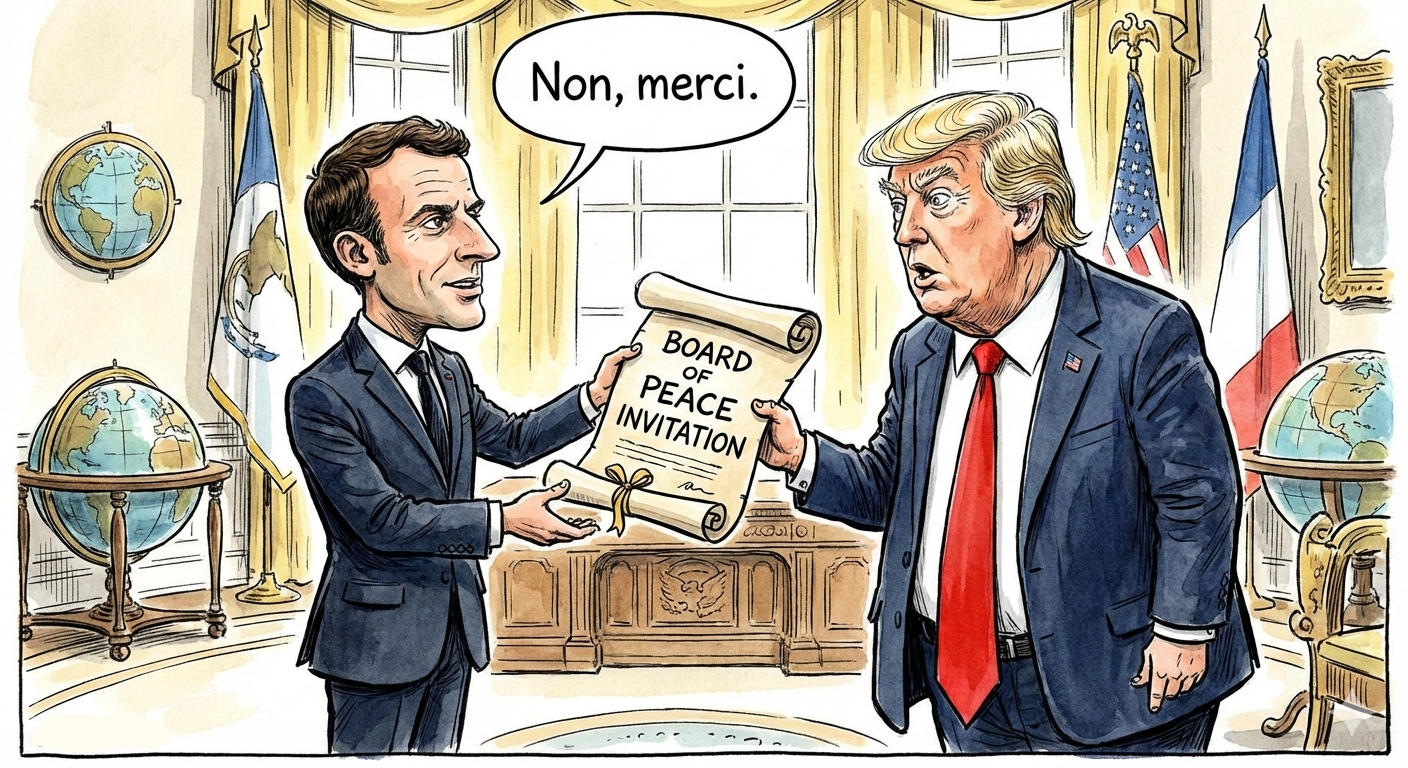
A source close to President Emmanuel Macron told Le Monde that France is unlikely to join the proposed Board of Peace at this stage, citing concerns that the initiative’s anticipated scope far exceeds the limited, Gaza-specific framework referenced in United Nations Security Council Resolution 2803. A subsequent statement from the French Foreign Ministry confirmed Paris’ concerns, noting that the Board’s emerging architecture appears to extend well beyond the transitional stabilization mandate thus far endorsed by the international community.
France’s position carries particular weight. As a permanent member of the Security Council and a consistent advocate for multilateral governance, Paris serves as a normative anchor for European sentiment. In this case, France’s hesitation reflects a wider pattern across the continent. While Hungary remains the only European state to explicitly accept an invitation, most others have responded with a “strategic silence”—a diplomatic practice that typically signals unresolved structural concerns rather than mere indecision.
The Governance Gap: Concentration of Authority
At the center of these concerns is the Board’s proposed governance model. Reporting on the draft charter suggests a structure that diverges sharply from established multilateral norms:
- Open-Ended Leadership: Donald Trump would be named the inaugural Chairman, with no fixed term limits and no clearly defined succession mechanism beyond the Chairman’s right to designate a successor.
- Centralized Decision-Making: All Board decisions would be subject to the Chairman’s final approval, effectively granting the office a unilateral veto over a body intended to manage global conflicts.
- Expansionist Mandate: While UNSC Resolution 2803 focused narrowly on a three-year post-conflict stabilization of Gaza, the draft charter describes a standing global body with its own “international legal personality,” raising the prospect that the Board could operate parallel to, or even independent of, the UN Security Council.
The “Pay-to-Play” Funding Model
The proposed funding model adds a further layer of institutional unease. According to the invitation letters, states seeking permanent membership are expected to contribute $1 billion in cash. While U.S. officials suggest these funds are for Gaza’s reconstruction, the draft charter leaves the management of this capital under the centralized control of the Chairman.
Canada’s position reinforces the skepticism surrounding this model. Prime Minister Mark Carney has indicated support in principle for the mission of Gaza stabilization, yet Canadian government sources have been clear: Ottawa will not pay the $1 billion fee for a permanent seat. This stance signals that even among the United States’ closest G7 allies, there is profound discomfort with a “tiered” membership system that appears to put a price tag on diplomatic influence.
The Strategic Shadow: From Gaza to Greenland
These institutional questions are being evaluated against a volatile strategic backdrop. In recent weeks, the tension between the U.S. administration and its European allies has shifted from rhetorical disagreement to economic friction. President Trump’s repeated assertions regarding the acquisition of Greenland—and his refusal to rule out military force to secure it—have ceased to be viewed as hyperbole.
The concern reached a breaking point following the January 17 announcement of 10% tariffs on NATO allies, including France and Germany, in response to their participation in “Operation Arctic Endurance.” For European defense establishments, these are not anonymous leaks but on-the-record declarations of intent against allied territory.
When a leader who is currently imposing punitive tariffs on allies over a territorial dispute proposes a new, standing conflict-management body with centralized authority, European officials view the proposal through the lens of sovereignty and risk. Their hesitation is a disciplined reading of observed behavior; they are understandably reluctant to join a body that could, in theory, be used to “arbitrate” or “legitimize” the very territorial pressures they are currently resisting in the Arctic.
Conclusion: The Davos Baseline
As the World Economic Forum at Davos approaches, France’s early signal provides a useful analytic baseline: absent a meaningful recalibration of the Board’s architecture and a clearer alignment with the UN system, broad European participation remains improbable.
European governments are unlikely to abandon Gaza; they will simply continue to channel humanitarian support through established, transparent mechanisms like the EU and UN agencies. By declining the invitation, France has provided the political space for other allies to hold the line, insisting that any “Board of Peace” must be anchored in international law rather than personal authority.